Market note·18 October 2021
Should you buy Initial Public Offerings (IPOs) or is there a less “risky” option?
An IPO is a company’s first offering of stock to the public . They are important to follow as 80% of the biggest winning stocks tend to be companies that IPO’d within the previous 10 years.
The reason being is that most of a company's growth usually occurs in the first few years after common stock is issued and the company goes public. During this time, the company's products or services expand into new, unexploited markets that are fueled by the capital raised from the IPO. During this pivotal phase, management usually shows its entrepreneurial excellence. As sales grow and economies of scale improve, margins are expanded, and profit growth accelerates.
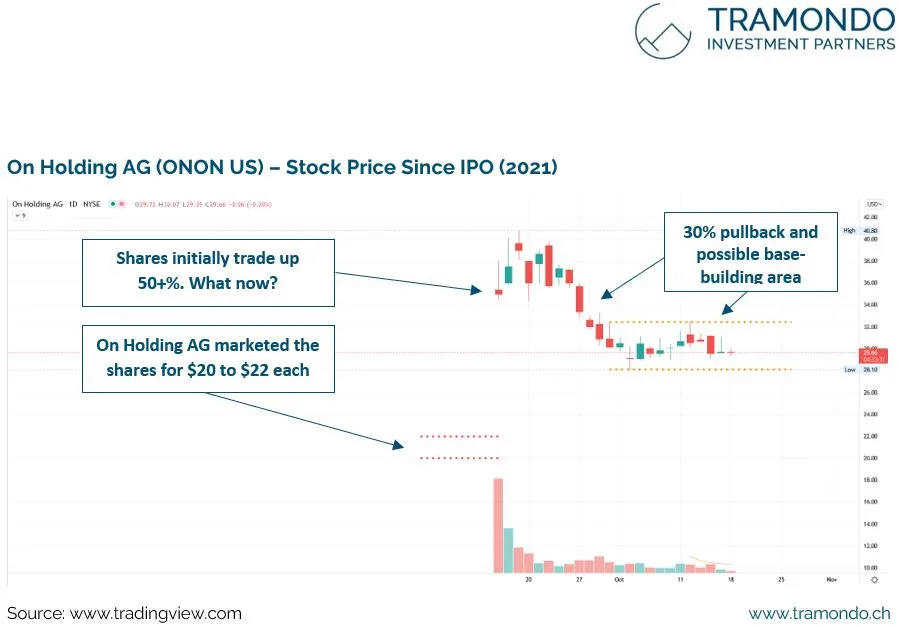
Most recently, many investors have asked us what we think of the Swiss company On Holding AG and its IPO (Chart 1).
We generally do not recommend that investors buy IPOs on day one. There are several reasons for this - and a much lower-risk approach to participate…
- Among the many IPOs that occur each year, there are a few standouts. However, those that are still outstanding are in such high demand by institutional investors that if you are able to buy them at all, you may only get a tiny allocation
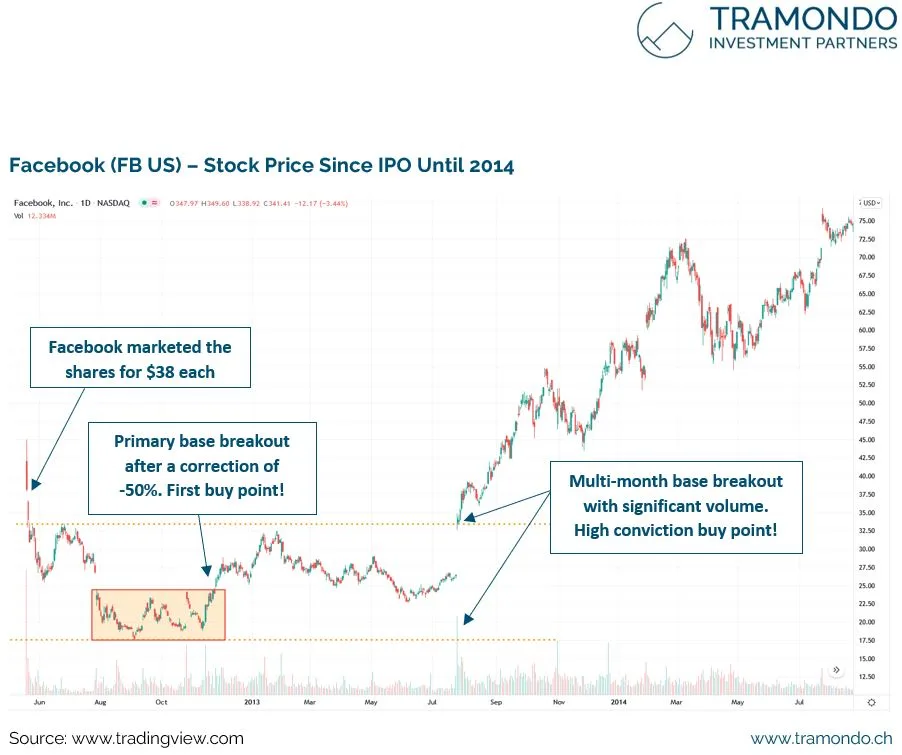
- Many IPOs are intentionally undervalued and therefore shoot up on the first day of trading (On Holding AG?), but quite a few could also be overvalued and fall (Facebook?)
- Since IPOs have no trading history, you cannot be sure if they are under- or overvalued. In most cases, this speculative area should be left to experienced institutional investors who have access to the in-depth research required and who are able to spread their new issue risks across different stocks
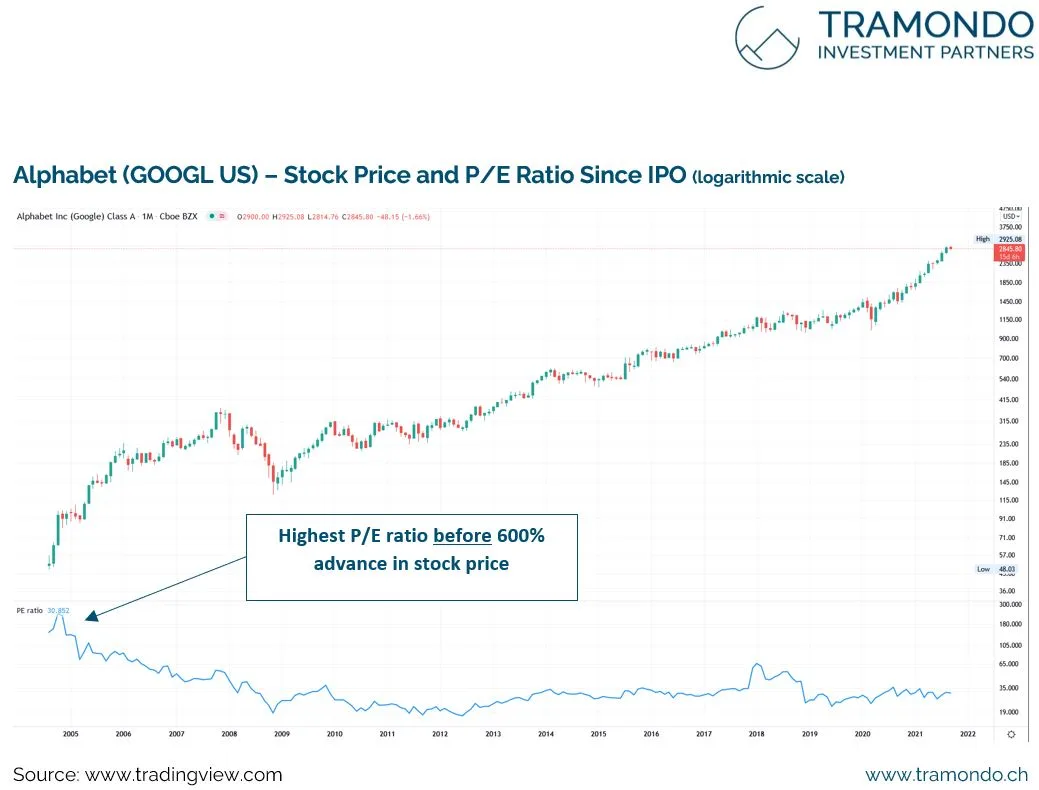
This is not to say that you cannot purchase a new issue after the IPO. They can be a great source of new ideas. E.g. Alphabet (Google) should have been bought in mid-September 2004, in the fifth week after its new issue, when it made a new high at $114 (Are Price-to-Earnings (P/E) ratios really important?).
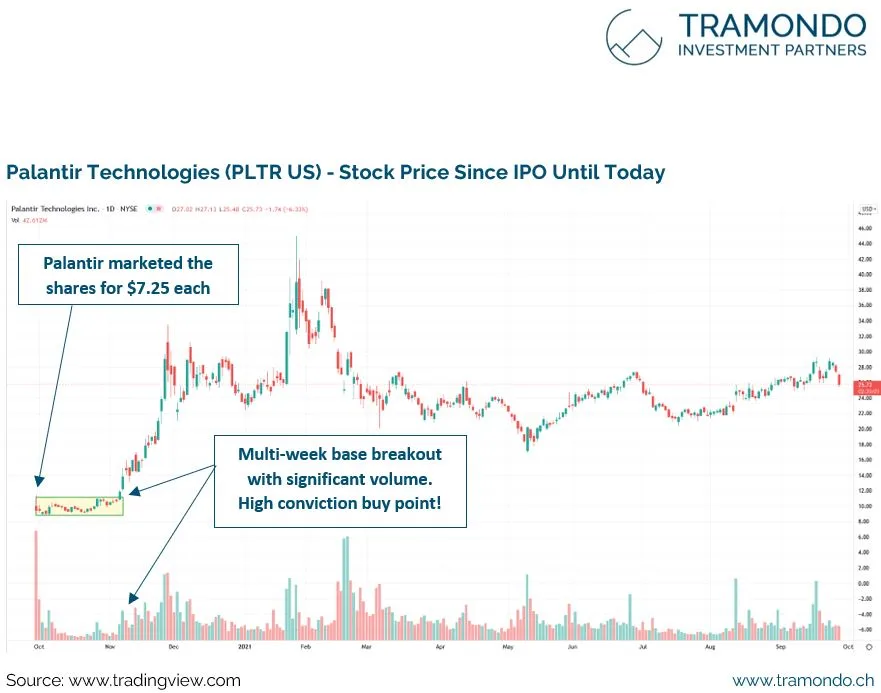
Consequently, the safest time to buy an IPO is on the breakout from its first correction and base-building area. Once a new issue has been on the market for one, two, three months or more, you will have valuable price and volume data with which to better assess the situation. For illustration purposes, let's look at the well-known Facebook IPO (Chart 2) and the recent Palantir Technologies IPO (Chart 3).
01
More market notes
01 / 01
More market notes
Market note · 1 Oct 2021
Our Five Thematic Investing Rules
Our five thematic investing rules
Market note · 16 Sep 2021
Are price‑to‑earnings (P/E) ratios really important?
Like most investors, you have probably learned the most important thing you need to know about a stock is its price-to-earnings (P/E) ratio.
Market note · 11 Aug 2021
Power Earnings Gap (PEG)
When earnings season is in full swing, every investor has his favorite setup to trade and follow.