
Reading list·Summer 2026
The human side of wealthFive books for the summer.
For the families and entrepreneurs we are privileged to accompany, the hardest questions about wealth are rarely about how it is built. They are about what it does once it exists - to a marriage, to siblings, to children who never had to earn it - and, in the end, what all of it is actually for. This summer we set the spreadsheets aside and turn to that more human reckoning.
01
The arc
01 / 03
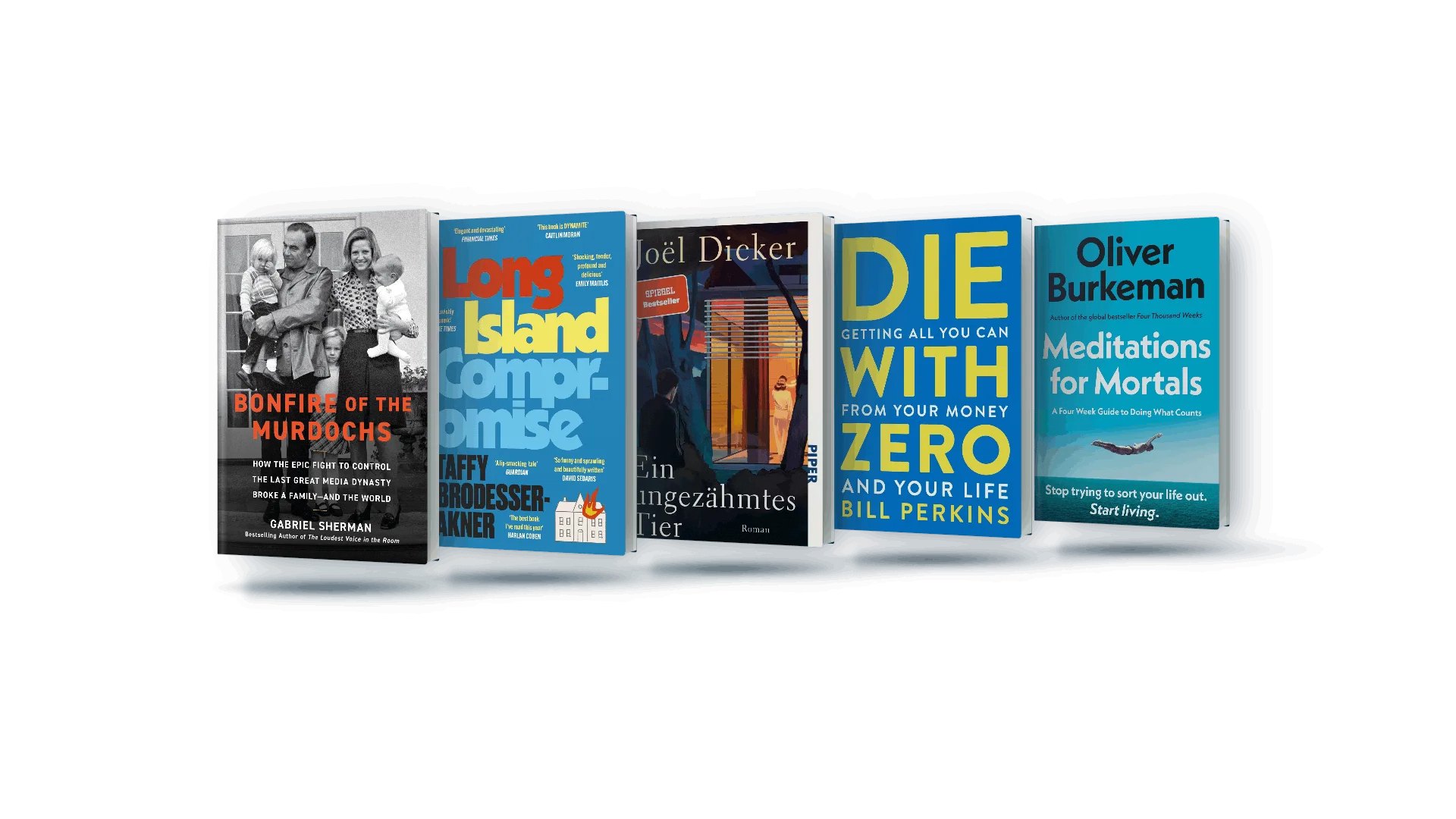
This season’s five books trace a single arc.
Read together, they form a meditation on intentionality: the difference between accumulating a fortune and authoring a legacy.
I
Two cautionary tales of inheritance
One drawn from the headlines, one from the imagination, in which a fortune becomes the very thing that fractures a family.
- Bonfire of the Murdochs
- Long Island Compromise
II
A Swiss summer thriller
Set among the villas of Lake Geneva: proof that the company of the very rich can also be wicked fun.
- Ein ungezähmtes Tier
III
Two quietly radical books
They turn the question around: not how to keep wealth, but what it is for, and how to spend a life on what truly matters.
- Die With Zero
- Meditations for Mortals
02
The books
02 / 03
01 / 05
Bonfire of the Murdochs
Gabriel Sherman
Some family dramas are invented for television; this one outpaced the screenwriters.
For our readers, the partisan furniture matters far less than the governance lesson beneath it. Stripped of its headlines, this is a study in how not to plan a succession — what happens when control is hoarded rather than shared, when heirs are tested rather than prepared, and when the architecture of a trust becomes a weapon instead of a safeguard. Every family that has built something worth passing on will recognise the underlying tension between the founder’s instinct for control and the next generation’s need for clarity, fairness and a defined role.
Read our full review
Bonfire of the Murdochs is the inside account of the succession battle over Rupert Murdoch’s media empire — a real‑life saga so operatic that the family themselves reportedly feared their secrets were reaching the writers of a certain TV series. At heart it is the story of a man who tried to script his own legacy and, in doing so, set fire to the very thing he most wanted to preserve.
Gabriel Sherman is uniquely placed to tell it. An award-winning journalist and screenwriter, he has covered the Murdochs since 2008 and is the author of the bestselling The Loudest Voice in the Room, about Fox News founder Roger Ailes; he also wrote the screenplay for the twice Oscar-nominated film The Apprentice. Drawing on interviews with more than 150 insiders, he reconstructs a quarter-century gamble: the patriarch’s belief that pitting his children against one another would reveal the most capable heir, and the collision that followed his eventual move to rewrite the trust governing the empire.
Critics have read it as exactly that kind of morality tale. Kirkus Reviews invoked the moral weight of King Lear, while the Financial Times saw the family’s disintegration not as a departure from Murdoch’s empire-building but as a product of the same ruthlessness. Reviewers praised Sherman’s command of his material even where they quarrelled with his sympathies — a reminder to read it for its human and structural insights rather than its politics.
The most expensive mistakes in wealth are rarely made in markets; they are made at kitchen tables and in lawyers’ offices, in the quiet decisions about who inherits what, and how. Sherman’s chronicle is a bonfire worth studying from a safe distance.
02 / 05
Long Island Compromise
Taffy Brodesser-Akner
If Sherman gives us the true story, Taffy Brodesser-Akner gives us its fictional twin
Her subject is one our clients know intimately: the paradox of inherited money as both shield and solvent. The Fletchers’ fortune assures the family its safety, yet it also corrodes ambition, deforms relationships and leaves the next generation unmoored — each child a different case study in what you become when you never have to become anything. The Los Angeles Times judged that the book belongs among the great American novels, while The Atlantic admired its exuberant, absorbing sweep and Publishers Weekly its incisive wit.
Read our full review
– and, arguably, its deeper truth. Long Island Compromise opens with the kidnapping of Carl Fletcher, the wealthy owner of a Long Island factory, who is returned to his family within a week. The ransom is paid; the family survives; and the novel then spends 400 luminous pages on the real subject: what that wealth, and that trauma, do to the three Fletcher children across the decades that follow.
Brodesser-Akner is among the most acute observers of money and class writing today. A celebrated journalist before turning to fiction, she earned wide acclaim for her debut Fleishman Is in Trouble, later adapted for television. Her second novel was named a Best Book of the Year by an unusually broad field — among them The New York Times Book Review, The New Yorker, Time, The Washington Post and NPR — confirming her gift for the big, old‑fashioned social novel told in a thoroughly modern voice.
We include a novel deliberately. Fiction reaches places financial planning cannot, and the most under-discussed risk in multi-generational wealth is not market risk or tax — it is the risk to character, to motivation, to family cohesion. Brodesser-Akner has written the most humane available field guide to that risk, and made it a pleasure to read on a summer afternoon.
03 / 05
Ein ungezähmtes Tier (Wild Animal)
Joël Dicker
Every summer list needs one book read purely for the pleasure of it — and this year it comes, fittingly, from the shores of Lake Geneva.
Crucially for our readers, it is available in German, French and English alike – an easy, elegant companion for the Swiss summer.
Read our full review
Ein ungezähmtes Tier (published in French as Un animal sauvage and in English as Wild Animal) is a domestic thriller set among the moneyed villas of Cologny and the luxury boutiques of central Geneva.
On the surface, Sophie and her husband are an enviably perfect couple; beneath it run obsession, surveillance and a meticulously planned jewellery heist. The masks slip one by one, and the pages turn themselves.
Joël Dicker is Switzerland’s most successful literary export of his generation. Born in Geneva in 1985, he achieved global fame with The Truth About the Harry Quebert Affair and has sold many millions of copies across some forty languages. He writes the world our clients actually inhabit — private banks, discreet fortunes, beautiful houses and the secrets they contain — with a storyteller’s gift for momentum.
Its relevance to this list is partly serious and partly a wink. Serious, because Dicker is a master of the gap between the polished surface of a wealthy family and the turbulence beneath — the same gap our two cautionary tales explore, here rendered as pure entertainment. And a wink, because stewardship is demanding work, and a guide worth its salt knows when to recommend something simply to be enjoyed in a deckchair. The Wall Street Journal praised its precision, comparing its workings to those of a finely made watch, while reviewers have likened its portrait of a seemingly idyllic community to the best of the genre.
04 / 05
Die With Zero
Bill Perkins
Having sat with what wealth can do to a family, we turn to what it is ultimately for.
We include a deliberate counter-thesis. Its argument runs against the instinct for preservation that defines much of our work — and that friction is precisely its value. Perkins handles the inheritance question with more care than his provocative title suggests: rather than leaving heirs to wait for a windfall in their sixties, he urges giving earlier, when capital lands with maximum effect in a younger life. For families weighing how and when to transfer wealth, that is a genuinely useful reframing, even for readers who would never embrace the literal arithmetic of zero.
Read our full review
Bill Perkins asks a heretical question: what if optimising for a deathbed transfer is itself the mistake?
Die With Zero argues, in essence, that hoarding capital for a final hand‑over is poor mathematics and poorer living – and that the wiser path is to convert wealth, intentionally, into experience and impact while you are alive to share it.
Perkins is no ascetic. A former hedge‑fund manager and high‑stakes poker player, he writes as a man who has thought hard about risk and timing. His central tools have become quietly influential: the idea of “memory dividends” — the compounding joy of experiences had at the right age — and the “time bucket” exercise of mapping the experiences you want to each decade of life, while the health and energy to enjoy them remain. First published in 2020 and since translated into some twenty‑five languages, the book has been endorsed across an unlikely spectrum, from entrepreneur Barbara Corcoran to the economist Laurence Kotlikoff.
Good stewardship is not only about defending capital; it is about knowing what the capital is for. Perkins will not change every mind, but he will sharpen every reader’s sense of purpose.
05 / 05
Meditations for Mortals
Oliver Burkeman
We close on the most reflective note of all. Where Perkins addresses the purpose of capital, Oliver Burkeman addresses the purpose of attention
For our readers, it is the perfect pairing with Die With Zero. Where Perkins reframes the spending of money, Burkeman reframes the spending of time and attention — and both arrive at the same destination: a life designed around what genuinely matters rather than what merely accumulates. For successful people accustomed to optimising and accruing, his invitation to choose, to forgo, and to accept finitude is both unfamiliar and freeing. The Financial Times welcomed its calm, humane counsel, and readers have found in it a rare antidote to the tyranny of the endless to‑do list.
Read our full review
– the scarcer resource of the two. Meditations for Mortals is a four‑week course in living within limits: a daily companion built around the bracing recognition that we will never get to everything, and that the secret to a meaningful life is choosing well what we will.
Burkeman writes from authority earned with readers worldwide. His earlier Four Thousand Weeks — a reckoning with the roughly four thousand weeks of an average human life — became an international bestseller and reshaped how many people think about time and productivity. Here he distils that thinking into something quieter and more practical: a philosophy he calls “imperfectionism,” and a set of meditations on letting go of the fantasy of doing it all.
It is a fitting close to a summer of reflection: a reminder that the ultimate scarce asset is not capital but time, and that stewardship, in the end, is as much about a life well spent as a fortune well kept.
03
More reading
03 / 03
The team at Tramondo wishes you a relaxing and inspiring summer break.
Please let us know what you think of this selection, and keep your recommendations coming.
Previous reading lists
Reading list · 2 Dec 2025
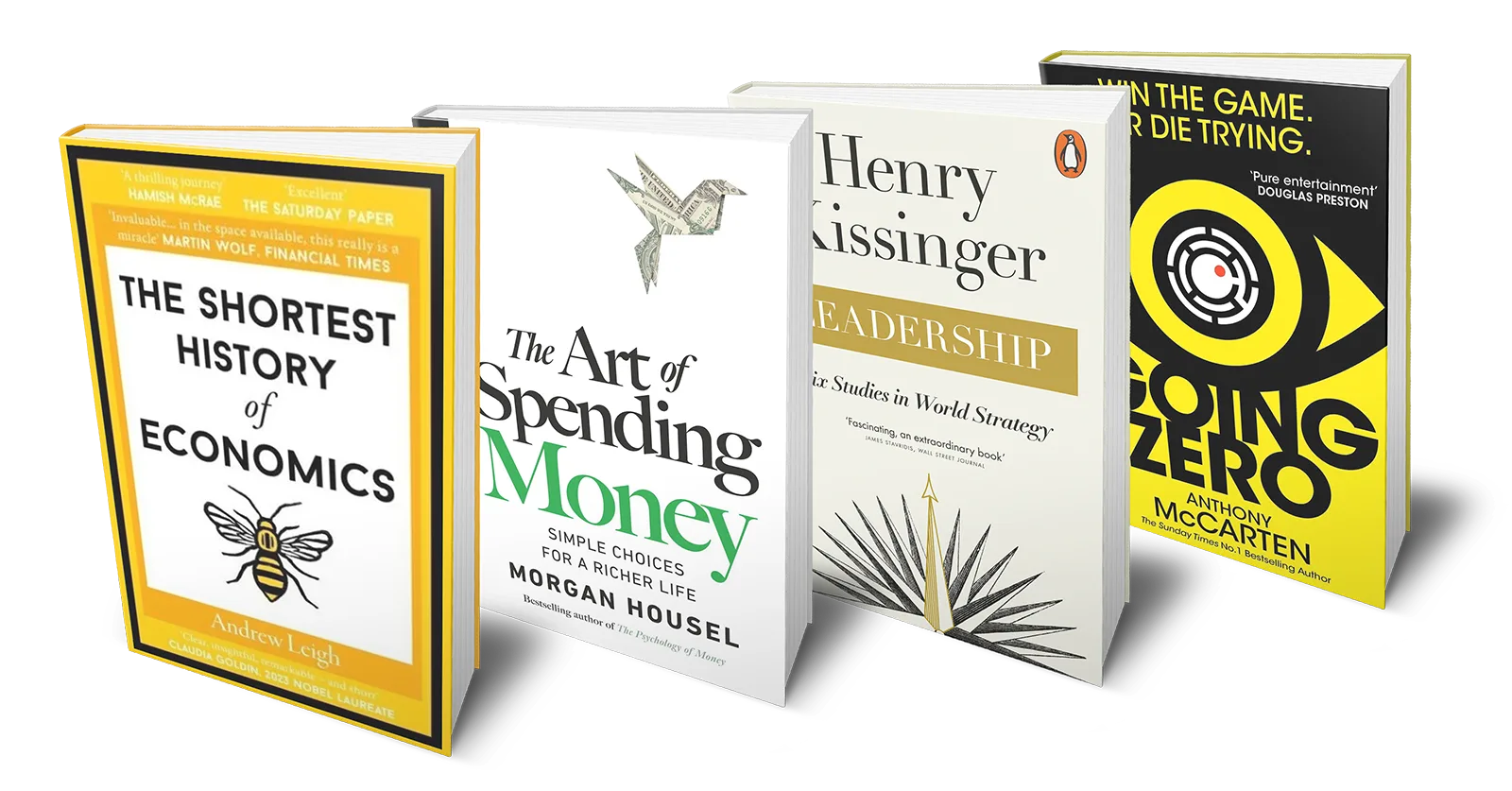
Year‑End ’25 Reading List - Economics, Psychology, Strategy, and Vigilance
Welcome to the Tramondo Year-End Reading List 2025, where we explore the enduring questions that shape wealth, leadership, and the quest for meaning in an increasingly complex world.
Reading list · 1 Jul 2025
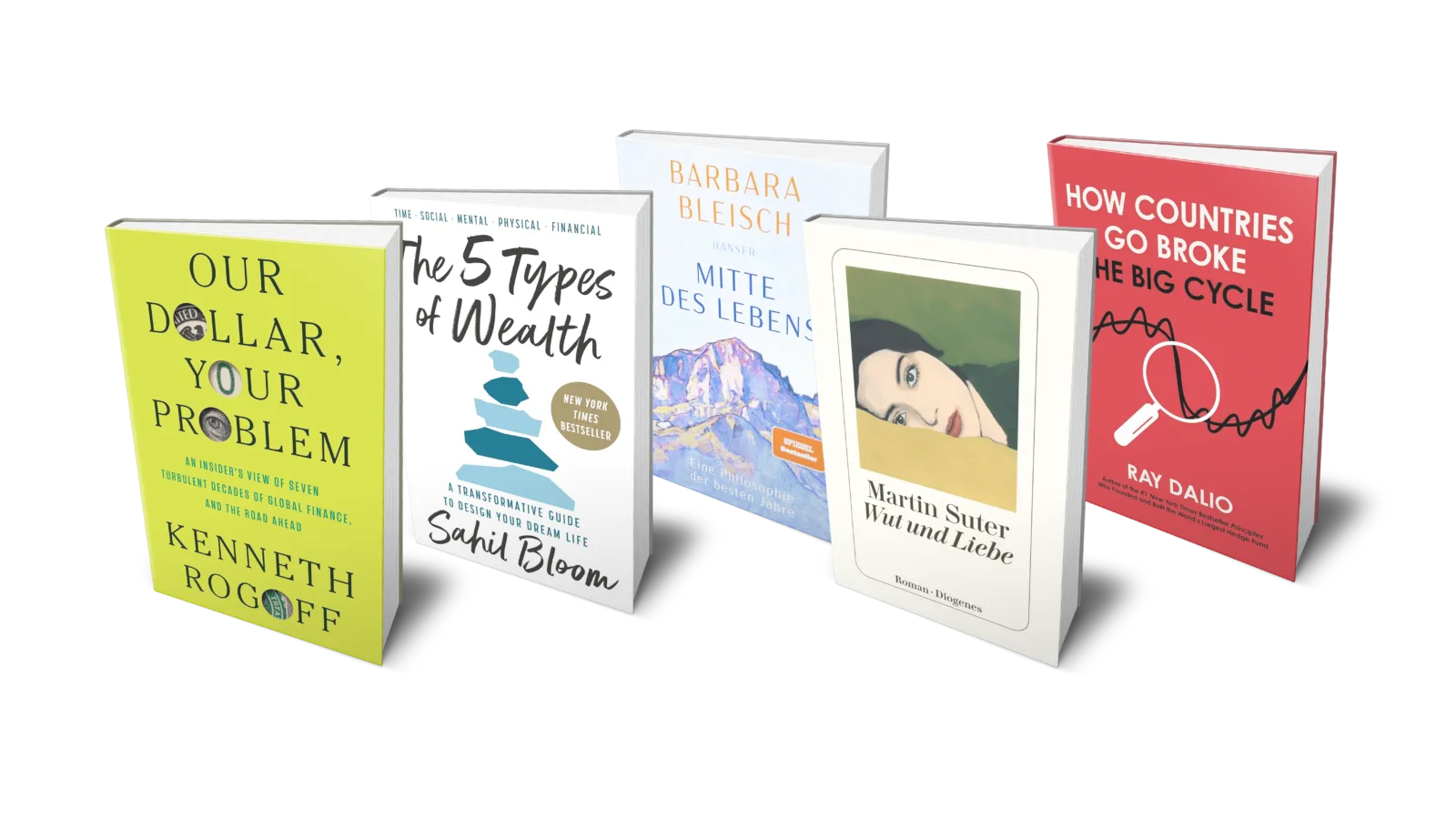
Summer ’25 Reading List - Navigating Power, Wealth, and Meaning in Times of Transformation
Welcome to the 2025 Tramondo Summer Reading List, where we explore the shifting foundations of power, the evolving definitions of wealth, and the eternal quest for meaning in an era of unprecedented …
Reading list · 5 Dec 2024
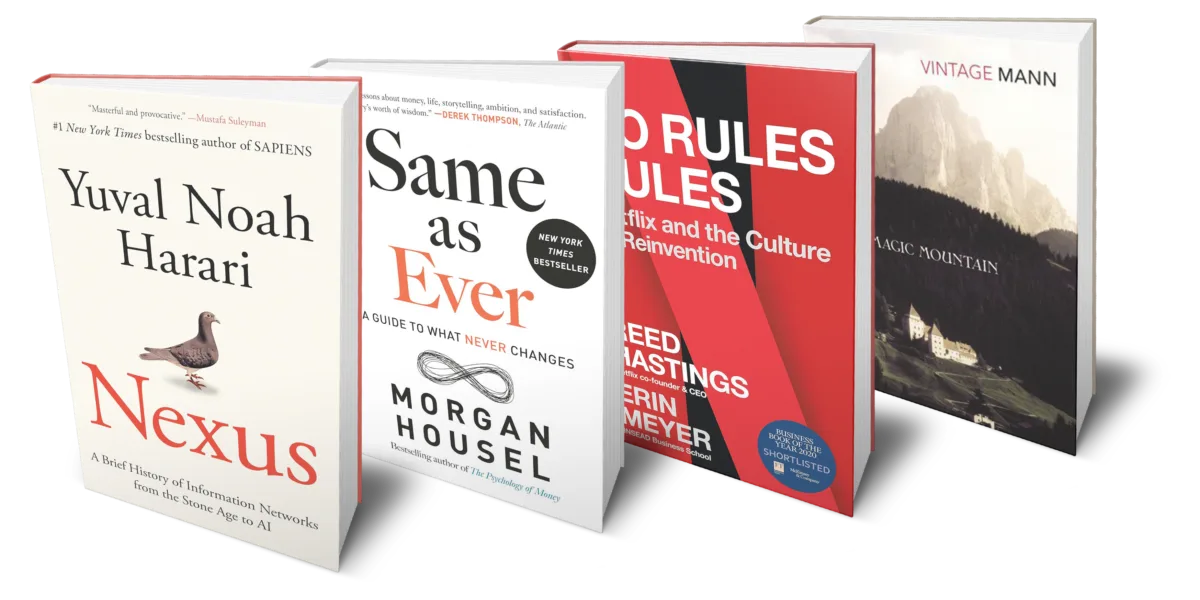
Year End ’24 Reading List
Welcome to the 2024 Tramondo Year-End Reading List, where the intricate tapestry of global information networks intertwines with the nuanced art of wealth creation and preservation. As we approach …