
January 2026
Equity markets enter the final sprint.
Global risk assets ended 2025 on a strong note, supported by a measured policy pivot in the United States and resilient earnings in AI-linked industries.
Published 8 January 2026By Investment TeamReading time 3 minAlso in German Marktkompass
Our view on the markets and investment strategy in the January 2026 Market Compass.
With valuations in key markets already discounting a fair amount of optimism, we expect earnings growth to be the principal driver of returns in 2026. Selectivity remains paramount: investors are likely to reward companies with robust balance sheets, durable profitability, and reliable cash flow. Just as importantly, separating sustainable innovation from narrative-driven hype will be a critical success factor as the AI theme evolves.
Fed eases while ECB holds
The Federal Reserve cut the policy rate by 0.25% to 3.5% to 3.75% at its final 2025 meeting and signaled only one additional move in the new reporting period, with a further step penciled in for 2027. The Fed also unveiled “Reserve Management Purchases” of short-term Treasuries to bolster market liquidity, echoing prior balance-sheet expansions in 2008 and 2020. By contrast, the ECB left rates unchanged as euro area inflation sits above target and policy is viewed as neutral, suggesting a cautious 2026 path.
Swiss equities sprint into year‑end
Since end Q3 2025, the SPI gained about 8.8%, outpacing the EuroStoxx50 (+4.7%), DAX (+2.6%), Nasdaq (+2.6%), and S&P 500 (+2.4%). A mid-November tariff dispute settlement with the United States and a September agreement between US President Trump and the pharmaceutical industry helped reignite momentum. Pharma leaders and mid caps rallied in Q4: Roche (+26.3%), Novartis (+9.5%), BB Biotech (+24.6%), and Sandoz (+22.6%).
Micron’s beat recharges the AI complex
Micron Technology topped estimates and surged 20.7% in December, with management highlighting AI infrastructure demand exceeding memory supply and projecting roughly 40% annual revenue growth through 2028. The read-across lifted the broader semiconductor space: Lam Research (+19.4%), TSMC (+15.4%), ASML (+12.9%), and Nvidia (+10.5%). The message is clear: earnings remain the arbiter of AI’s staying power.
EV leaderboard reshuffled
Tesla ceded its global EV crown to BYD in 2025 as deliveries fell 9% to 1.64 million vehicles, marking a second consecutive annual decline. BYD sold 2.26 million EVs, up 28% year on year, driven by successful expansion in Europe. Competitive intensity and regional mix will be key profit drivers in 2026.
Silver eclipses gold
Gold rose about 65% in 2025 after a 27% gain in 2024, aided by central bank buying, de-dollarization, tariff uncertainty, and US fiscal concerns. Silver outpaced dramatically, returning 148% as it benefited from the same macro tailwinds plus structural industrial demand in electrification, semiconductors, and EVs. With the gold-silver ratio near 60, close to its long-term 60-70 average, we remain constructive on both metals in 2026. Source: Bloomberg.
What’s next and how we are positioned
Q4 2025 earnings begin in the second week of January. Results from AI leaders will likely set the tone for US equities, either extending momentum or inviting consolidation. Our tactical stance favors quality: Cash 2/5, Fixed income 4/5 with a bias to USD and EUR investment grade, Equities 3/5 with preference for the United States and select opportunities in Japan, Vietnam, and very selectively China, and Alternative investments 3/5.
Download the full Market Compass JANUAR 2026 PDF
Access our in-depth 2026 outlook, sector and regional playbooks, fixed income implementation ideas, and our gold and silver thesis. Download the PDF now to explore our scenarios, risks, and portfolio positioning in detail.
Ready to dive in?
Download the full PDF of our January 2026 Market Compass for a detailed analysis and forward-looking guidance on navigating today's financial markets.
Do not hesitate to contact us with any questions about the topics discussed. We are happy to assist you with our expertise.
01
The full edition
01 / 03
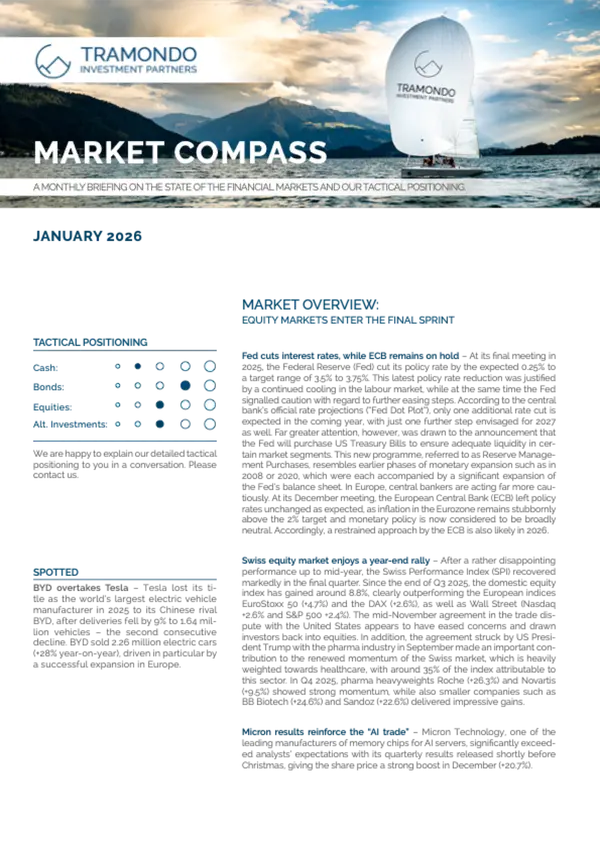
Read the full Market Compass. January 2026.
Our in-depth outlook with scenarios, risks and positioning, as published: the edition as a PDF, in English and German.
- Market Compass, January 2026PDF · English
- Marktkompass, Januar 2026PDF · Deutsch
02
By e‑mail
02 / 03
Get the Market Compass by e‑mail
Every month, in English or German.
03
Previous editions
03 / 03
Previous editions

Market Compass · 6 Nov 2025
Market Compass November 25 - Earnings Fireworks in the Valley, a truce - for now
Our view on the markets and investment strategy in the November 2025 Market Compass.
Market Compass · 6 Oct 2025
Market Compass October 25 - Gridlock in Washington, Movement on Wall Street
Our view on the markets and investment strategy in the October 2025 Market Compass.
Market Compass · 5 Sep 2025
Market Compass September 25 - Powell opens the door – Putin blocks progress – Trump loses in court
Our view on the markets and investment strategy in the September 2025 Market Compass.