
March 2026
AI skepticism and tariff reform.
Despite the volatility triggered by the geopolitical escalation in the Middle East and rising energy costs, we are maintaining a neutral weighting of equities and bonds due to robust corporate earnings and stable economic indicators.
Published 5 March 2026By Investment TeamReading time 3 minAlso in German Marktkompass
Our view on the markets and investment strategy in the March 2026 Market Compass.
Beneath the surface, a historic rotation is underway: the equally weighted version of the S&P 500 has outperformed its market-cap-weighted counterpart by more than six percentage points since the beginning of the year - the widest divergence at this point in a year since 1992.
AI reality check reshapes markets
The so-called "AI trade" experienced a significant narrative shift in February. Investors moved from pure growth optimism to pricing in the disruptive impact of artificial intelligence on software and services. While the S&P 500 ended the month near all-time highs, this superficial calm masked extreme volatility at the individual stock level. Nvidia exceeded high expectations in its quarterly report, yet the market focus shifted to the astronomical capital expenditure plans of its hyperscaler customers, sparking a heated debate about the sustainability of returns on investment across the technology ecosystem.
Transatlantic divergence intensifies
While the S&P 500 struggled to find clear direction, European benchmarks embarked on a powerful upward trend. After years of US dominance, the "old economy" orientation of European indices transformed from a structural burden into a significant tactical advantage. Investors shifted capital into energy, commodities, transportation, and industrial infrastructure. This enabled Europe to capitalize on upside potential from cyclical and value-oriented cash flows, while investors simultaneously reevaluated their positions in US equities.
Tariffs back in focus after Supreme Court ruling
A landmark 6-3 Supreme Court ruling invalidated the US government's use of the International Emergency Economic Powers Act, overturning the high "reciprocal" tariffs that had dominated 2025. Within hours, the White House pivoted to Section 122 of the Trade Act of 1974, imposing a new 10% global surcharge on most imports. With Section 122 powers limited by law to 150 days, the market is bracing for intense legislative maneuvering and a potential wave of refund claims totaling up to $175 billion for the now-invalidated tariffs from 2025.
A regime change beneath the surface
More than 60% of individual stocks in the S&P 500 outperformed the index itself since the beginning of the year - a dramatic reversal from 2023 to 2025, when this share was at a maximum of 30%. The equal-weighted index has risen 6.8%, far outpacing the traditional index's modest gain of 0.5%. Energy, industrial, and consumer staples sectors have all posted double-digit gains this year, pointing to a more balanced and healthier market environment. For active managers and stock pickers, this offers fertile ground beyond the crowded megacap names.
Paradigm shift in Japan
At the beginning of 2026, the correlation between the Japanese yen and the TOPIX stock index turned positive for the first time since 2005. Such a parallel uptrend between currency and stock market is historically rare and has primarily occurred in major structural upward cycles, indicating a fundamental reassessment of the region by investors.
Middle East escalation and the oil factor
Following the launch of "Operation Epic Fury" by the US and Israel against Iran's military and nuclear infrastructure, Tehran responded with retaliatory strikes and announced the closure of the Strait of Hormuz, through which around one-fifth of global oil production is transported. A sustained rise in oil prices would tighten financing conditions, put pressure on profit margins, and rekindle fears of stagflation. However, history offers some reassurance: geopolitical shocks in the Middle East have usually triggered sharp but short-lived sell-offs, followed by stabilization within a few weeks.
How we are positioned
We maintain a neutral stance across major asset classes: Cash 2/5, Fixed Income 3/5 with a clear focus on investment-grade quality, Equities 3/5 supported by robust Q4 2025 earnings and improving purchasing managers' indices, and Alternative Investments 3/5. Gold remains strategically interesting, especially amid geopolitical conflict, and we see good reasons to use any setbacks to gradually build positions.
Download the full Market Compass March 2026 PDF
Access our in-depth outlook, regional playbooks, fixed income implementation ideas, and our detailed thesis. Download the PDF now to explore our scenarios, risks, and portfolio positioning in detail.
Do not hesitate to contact us with any questions about the topics discussed. We are happy to assist you with our expertise.
01
The full edition
01 / 03
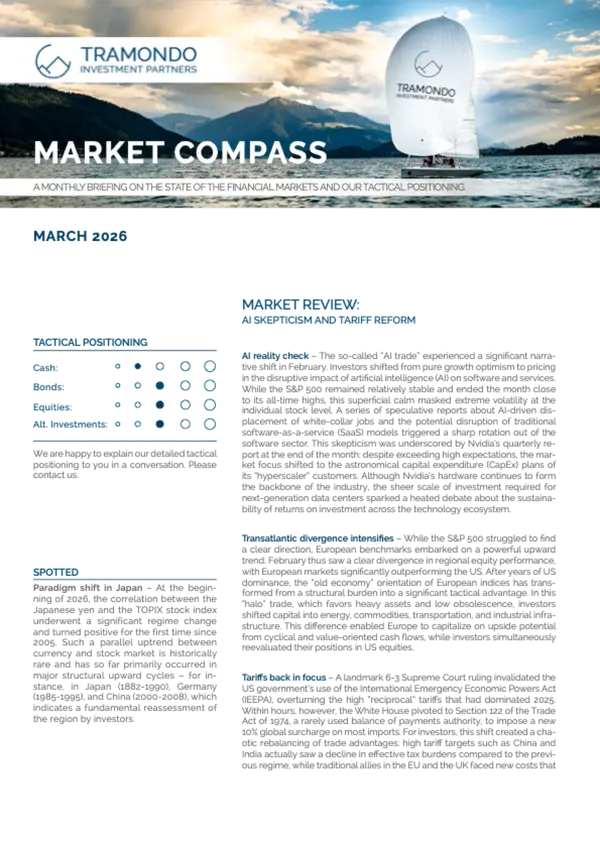
Read the full Market Compass. March 2026.
Our in-depth outlook with scenarios, risks and positioning, as published: the edition as a PDF, in English and German.
- Market Compass, March 2026PDF · English
- Marktkompass, März 2026PDF · Deutsch
02
By e‑mail
02 / 03
Get the Market Compass by e‑mail
Every month, in English or German.
03
Previous editions
03 / 03
Previous editions

Market Compass · 5 Feb 2026
Market Compass February 26 - Powell stands firm, commodity markets falter
Our view on the markets and investment strategy in the February 2026 Market Compass.
Market Compass · 8 Jan 2026
Market Compass January 26 - Equity markets enter the final sprint
Our view on the markets and investment strategy in the January 2026 Market Compass.
Market Compass · 6 Nov 2025
Market Compass November 25 - Earnings Fireworks in the Valley, a truce - for now
Our view on the markets and investment strategy in the November 2025 Market Compass.