
September 2026
Tech back on track, Fed keeps its foot on the brake.
Technology stocks staged a decisive comeback in August, with the semiconductor sector returning to positive territory after July's sharp correction. Meanwhile, Fed Chair Kevin Warsh delivered a clearly hawkish message at Jackson Hole, keeping the door open for further rate hikes.
Published 3 September 2026By Investment TeamReading time 3 minAlso in German Marktkompass
Our view on the markets and investment strategy in the September 2026 Market Compass.
As we enter September - historically the weakest month for the S&P 500 in midterm election years - selectivity and disciplined positioning remain essential.
Tech back on track as AI cycle powers ahead
Following July's correction, technology stocks rebounded strongly in August, led by the semiconductor sector. Nvidia surged +10.0% after reporting revenue that doubled year on year to USD 96.2 billion, while guidance of USD 108 billion for the current quarter once again exceeded elevated expectations. The rebound confirms our prior assessment: the correction did not represent a fundamental shift away from the AI investment theme. The S&P 500 gained +2.6% and the Nasdaq 100 advanced +4.2%, while European markets lagged with the EuroStoxx 50 up just +1.0% and the Swiss SPI declining -0.3%, weighed down by Nestle (-2.7%), Novartis (-2.6%) and Roche (-0.2%).
Fed Chair Warsh keeps the door open for further rate hikes
At the Jackson Hole symposium, Fed Chair Kevin Warsh delivered a clearly hawkish message. Despite more encouraging inflation data and early signs of labour market cooling, Warsh stressed that inflation remained well above the 2% target and that underlying price pressures had not improved sufficiently. The market implied probability of a September rate increase rose from around 35% before the speech to almost 60% afterwards. The monetary policy outlook remains firmly dependent on incoming data.
Middle East conflict keeps oil markets on edge
Diplomatic efforts between Iran and Oman over a temporary shipping corridor through the Strait of Hormuz failed to produce a lasting agreement. Tensions escalated further when US forces struck Iranian missile positions on Larak Island, prompting retaliatory attacks on US bases in Jordan. Brent crude rose back above USD 90 per barrel, and shipping through the Strait remained significantly restricted. The conflict continues to represent a meaningful risk factor for global inflation and central bank flexibility.
Bessent intervenes in the bond market
US Treasury Secretary Scott Bessent attracted considerable attention with a surprise announcement that the Treasury would at least double its purchases of long-dated government bonds to curb the sharp rise in yields. The move initially pushed yields lower and weakened the US dollar, supporting the gold price. However, the market reaction proved short lived as investors remain sceptical that technical measures can sustainably offset concerns surrounding high government deficits and persistent inflation.
Midterm election seasonality - a historical perspective
In midterm election years, September has historically been the weakest month for the S&P 500, with an average decline of around 1.5%. However, this period of weakness has often marked the starting point for a strong recovery, with October and November recording average gains of around 2.4% and 2.2%, respectively. We monitor these seasonal patterns closely but never consider them in isolation.
How we are positioned
We remain constructive on equities over the medium term and maintain our overweight position, though we would not chase markets following the recent recovery. The greatest risk to our outlook comes less from the corporate side and more from a potential sustained breakout in long-term US yields. Our tactical stance: Cash 2/5, Fixed Income 3/5 with caution on duration risk, Equities 4/5 with a firm preference for the US, and Alternative Investments 4/5 with gold as our highest conviction holding.
Download the full Market Compass September 2026 PDF
Access our in-depth outlook, regional perspectives, fixed income positioning, and our detailed thesis on gold, AI infrastructure and geopolitical risk. Download the PDF now to explore our scenarios, risks and portfolio positioning in detail.
Ready to dive in?
Download the full PDF of our September 2026 Market Compass for a detailed analysis and forward-looking guidance on navigating today's financial markets.
Do not hesitate to contact us with any questions about the topics discussed. We are happy to assist you with our expertise.
01
The full edition
01 / 03
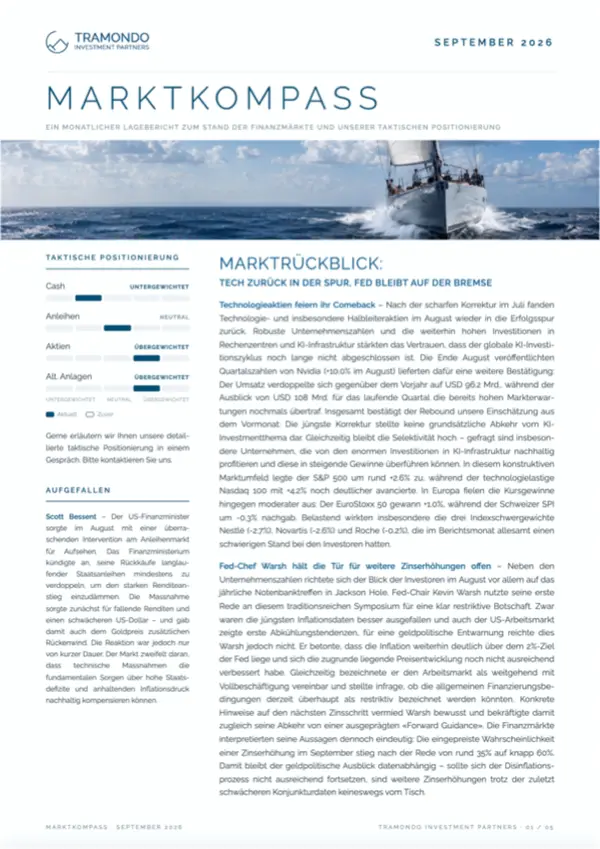
Read the full Market Compass. September 2026.
Our in-depth outlook with scenarios, risks and positioning, as published: the edition as a PDF, in English and German.
- Market Compass, September 2026PDF · English
02
By e‑mail
02 / 03
Get the Market Compass by e‑mail
Every month, in English or German.
03
Previous editions
03 / 03
Previous editions

Market Compass · 5 Aug 2026
Market Compass August 26 - AI euphoria gives way to increasing selectivity
Our view on the markets and investment strategy in the August 2026 Market Compass.

Market Compass · 6 Jul 2026
Market Compass July 26 - De‑escalation in the Middle East, but monetary headwinds persist
Our view on the markets and investment strategy in the July 2026 Market Compass.

Market Compass · 4 Jun 2026
Market Compass June 26 - AI boom overshadows weak market breadth and geopolitical risks
Our view on the markets and investment strategy in the June 2026 Market Compass.